My Healing Yard

If you have ever wandered up my driveway to socialize, have dinner, perhaps a healing session or a holistic class, or maybe an evening campfire, you know my yard's wildness! The first 2/3's, moving up my driveway, is wild and free. My backyard is overrun with wild plants.
When my Dad visits he always asks: "Do you want me to come over with my lawn tractor and help you mow this place?" He loves to taunt me about my weeds. (Shhh, never call them weeds to their "blossom." Such rudeness hurts their feelings!)
My yard, a disaster to my Dad, is a healing oasis to me. I nurture wild plants that will heal asthma to zits, cancer to psoriasis, provide birth control options, heal your body's inflammation, and everything in between. Annoying weeds they may be to most, to me they are my humble, healing friends that I protect with the gentle fierceness of a mother. And, they graciously feed butterflies, bees, hummingbirds, and so many more wild creatures!
(All of the healing hints I will give, below, for my beloved weeds are but the tip of the iceberg for what each magical plant can be used for. Every plant has so many healing uses!)
Here we have Mullein (It is the tall plant with the yellow flower stalk), an amazing healing plant for asthma and your body's glands. Mullein oil can be rubbed over the thyroid, the ovaries, the testicles, or any gland and you can take mullein tincture to nourish all your glands from the inside of your body.

Yeah, I have a few cats about the home who like to get into the photo ops! The Milk Weed, hanging out here with my friend Mullein, is also good for asthma, constipation, and is reputed to be anti-fertility by the Mohawks. Milk Weed makes a fun, pink jelly for smearing on winter toast... don't forget the butter!
Got zits? Try Dandelion leaf and root tea. Add some Burdock Root and Red Clover flowers to this mix and you have a gentle liver and skin nourishing blend.
Of course, I would add my best friend Stinging Nettles to the above and every healing herb recipe. It just makes good nourishing sense to add nettles!

Red Clover Blossoms!

Dandelion's useful parts: leaf, flower, root. Burdock Root.. you have to dig it OR buy some from The Kent Family Growers or Birdsfoot Farm!

Dandelion leaves... and underneath the leaves, for fall harvesting, are the roots.
Cancer? The above blend does wonders to cleanse/nourish the liver and blood so your immune system can do its job in healing and removing cancer from the body. Add some peppermint (below) as its healing oils and chemical constituents are amazing healing energy for digestive tract issues!

Thank you, Robin, for this wonderful mint variety. Seems the deer like it too! Smart animals.
Want to increase fertility and your ability to conceive? Try a tea (medicinal strength infusion) of Red Raspberry leaf (below), Red Clover Blossoms (picture above), and Stinging Nettles (below). The link above has a "recipe" for a liver detox infusion. Follow the same principles when making your "Fertili-Tea." No simmering of the infusion is needed as you are using all leaves and flowers. Just steep the infusion overnight.

Red Raspberry Leaf, while you are collecting leaves for making tea... eat the berries!

Stinging Nettles, nestled up against my home.
Want to decrease fertility? Chicory Root tea (below) decreases sperm count. Milkweed (see above) decreases female fertility. Queen Anne's Lace, Wild Carrot (below), decreases female fertility and prevents pregnancy.
Red Raspberry Leaf (above) nourishes the uterus and reproductive tract throughout a female's life cycle. My plant intuition says it has to be nourishing for males as well.
There are many herbs to control fertility, enhance pregnancy and birthing, and nourish the reproductive tract. That is a whole book waiting to be written OR grab a copy of Susun Weed's Childbearing Years. This is a great place to start in learning female reproductive herbs.

Chicory: the root is used as a medicinal infusion to decrease sperm count.

Queen Anne's Lace flower head: the seeds are used to prevent pregnancy.
The below Black Eyed Susan patch adorns the yard behind my house and garage (and you are only seeing about 1/5 of this flower patch!). I leave it wild purely to heal my heart and soul (and my cat's as well... all 4 cats seem to love their wild flower jungle!).
Native Americans used the plant for internal parasites, skin wounds, earaches, snake bites, and the common cold.

Wild plants are wonderful. Befriend one today! Paula
PS Stay tuned for Healing Backyard Plants, Pt 2
AND
The Healing Powers of the Great White Pine
Weeds, To Eat or Not To Eat!
www.HandsOnHealthHH.com
Holistic Hugs & Peaceful Blessings!
Paula M. Youmell, RN, MS, CHC
Holistic Health, Nutrition & Fitness Counselor
(315) 265-0961
"Just lift the corner of the clouds and the sun is
ALWAYS shining!" Eli Schechter

Spring Nettles poking out of my home garden plot, Spring 2014

Weeds to one person are another person's medicine!
I love spring for the wonderful green plants shooting out of the earth around my home, in the woods and fields. These plants remind me of the ever changing and newness of life, the bounty of good food right outside our doors, and the nutritional value and healing properties of what many people consider weeds. I personally await the spring's wild leeks, dandelion greens, first nettle shoots, plantain leaves, rhubarb shoots, and so many more spring edibles.
These spring edibles awaken our taste buds, livers, digestive tracts, and each and every body cell. The incredible amount of nutrients in the plants adds to our nutritional stores and cleans our winter blood, liver, and digestive tracts.
What a relief to move away from my beloved winter root veggies (beets!) and begin incorporating our natural spring foods.
For more thoughts on the whole food-ness of herbs (weeds) click here.

Dandelion greens and flowers; good for liver health!
Fun Food Focus
Spring Greens Soup
I gather several kinds of spring greens: dandelion, plantain, lambs quarters, nettles, mustard greens, sorrel, violets... the list goes on. (Learn to identify them, pick and enjoy!)
I gently wash them, throw them in my blender with some raw goat's milk and wild leek shoots and leaves. Blend into a puree and warm gently.
You can also saute' the wild leek, ever so gently, then toss in the green and saute' for 1-2 minutes before blending.
Easy greens to start with are dandelion, plantain, nettles and violets.
Another idea: mix them in a salad with local, mixed baby greens - they should be available soon! Dress with raw - apple cider vinegar, organic - extra virgin olive oil and a few dried spices. Yummy!
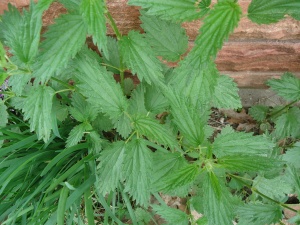
This picture taken today, 5-16-14. The nettles are getting larger!
Bonus information: Check out Martin's Farm Stand website, you can pre-order your fresh, local, seasonal produce, on-line! Cutting edge - local food access!
Wild Leeks & Wild Child!
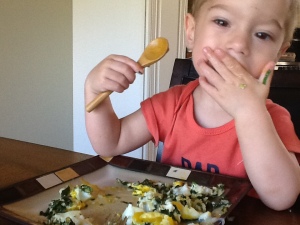
My youngest buddy, eating his morning, local eggs with wild leeks! His body is being infused with the nourishing goodness of wild foods.
- Wild foods have their genetics intact, non- GMO! This is a huge boost in your personal cell nourishment arena.
- Wild foods are grown in soil that generally has not been disturbed by agricultural chemicals: pesticides, fungicides, herbicides, synthetic fertilizers, on & on & on... if chemicals are in the soil, they are in every cell of your food (despite the "just wash it off" campaign of Big Ag.) Support local farmers who opt to not use chemicals.
- The soil, in the wild, is naturally composting, year after year. This continual composting cycle keeps the soil's nutrients high. Foods grown in this soil, well, are naturally high in minerals.
There is so much more to be said for food being grown in its natural environment, living and growing the way it would without human intervention. Growing food naturally, even when we cultivate it, raises the nourishment level by leaps and bounds.
Looking for local food, raised naturally? Don't want to grow it yourself OR forage in the woods? Get on this website and find a local farmer. who will love you up with good food and you can support their desire to produce good food. It's a win-win relationship!
Want to help others enjoy well raised, local food? The healthier people we have in our communities, the healthier our communities will be. It takes a community to raise a community!
The gift of good food is the best gift you can give. (in my opinion!)
I have pasted GardenShare's request for CSA Bonus Bucks support below.
Eat well, share good food, love people. Paula
CSA Bonus Bucks Needs Your Help!

Hello Friends,
GardenShare's CSA Bonus Bucks offers low-income families an opportunity to join the CSA of their choice with a $100 discount.
This year we've been overwhelmed with requests, and do not have the funding to cover five families who came in just as we had spent the final funds for the year. Some of these families have enjoyed this program for several years.
CSA Bonus Bucks works double duty by helping low income families enjoy great, healthy, local food, while at the same time, supporting our local farmers with additional business.
Any donation will help. Simply follow this link.
If you prefer, you can still send a check to
GardenShare, PO Box 516, Canton, NY 13617

Breakfast of Champions
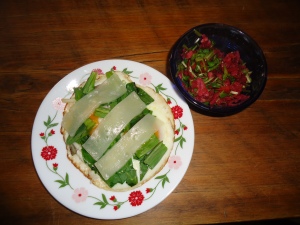
No - No you people of the 70's and 80's (myself included), it is not Wheaties!
So what is this concoction on the plate and in the bowl?
- Local, pasture raised eggs fried to the perfect, "still liquid" yolk state,
- Wild leeks chopped and placed on top, and
- Local, pasture-raised, goat milk cheese, slightly melted, on top... and in the bowl?
- Kraut made from Kent Family Farm's root veggies, cabbage, and burdock with added: fresh wild leeks from around the corner and up the hill; then I added dandelion greens, nettle tops*, and chives from the front yard.
Yummy, cell nourishing way to start the day!
*The nettle tops were raw, chopped very finely. Yes, nettles will leave the characteristic "sting" on the tongue and back of the throat... but it is very mild, barely noticeable!
Stinging nettles have been used for urtication. Urtication means flailing the affected joints with nettles for the relief of arthritis and like conditions. So eating raw is a 'lil self tongue and throat therapy! Who would want arthritis of throat and tongue?

Sustainable Harvesting & Preserving Wild Leeks
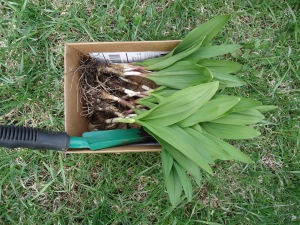
Wow, many questions about the wild leeks.
When digging, never take more than 5% of the patch. This ensures the patch will survive and spread for many decades to come. If the patch is where others harvest as well, take much less than 5% of the patch.
Wild leeks are becoming over harvested and now are hard to find in many areas.
Here is a recipe for pickled leek bulbs. This recipe had the least amount of sugar. I would use maple syrup, not honey.
If maple syrup is not available in your area, use the honey or unrefined sucanat sugar. 2 tablespoons of honey or maple syrup = 4 tablespoons of unrefined sugar.
http://foodpreservation.about.com/od/Pickles/r/Pickled-Ramps-Recipe.htm
Thanks to Leda Meredith for this recipe. http://ledameredith.net/wordpress/
I would skip the boiling water bath and just store them in the fridge. I bet they will keep much longer than 3 months. Put the jars to the very back of the fridge, where it is the coldest, BUT do not forget them there.
Definitely let them sit for 1 week to meld flavors.
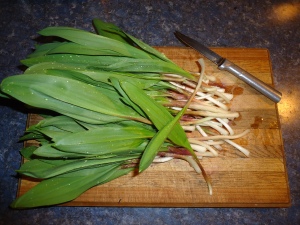
Wild Leeks
4/25/14 The Leeks are Back! YAY!
Seeing them in the woods, after a long winter, nourishes my soul!
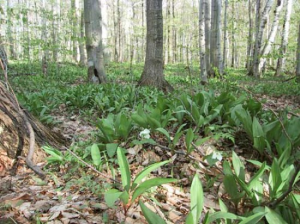
Digging them, with the prospect of taking home for dinner, nourishes my body.
Knowing that peas, asparagus, dandelion greens, stinging nettles, spinach, and strawberries are just around the corner nourishes my mind.
No more snow, correct?
More leeks dug 4/26...
Fine chopped for my last batch of sauerkraut for the season...

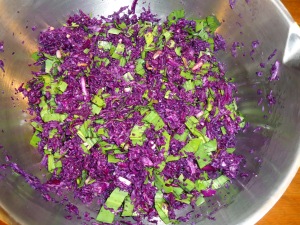
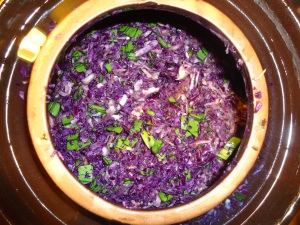
Packed down into the kraut crock... 14 days and voila' wild leek infused sauerkraut! Want to sample? I will dig it out of the crock around the 12 of May.